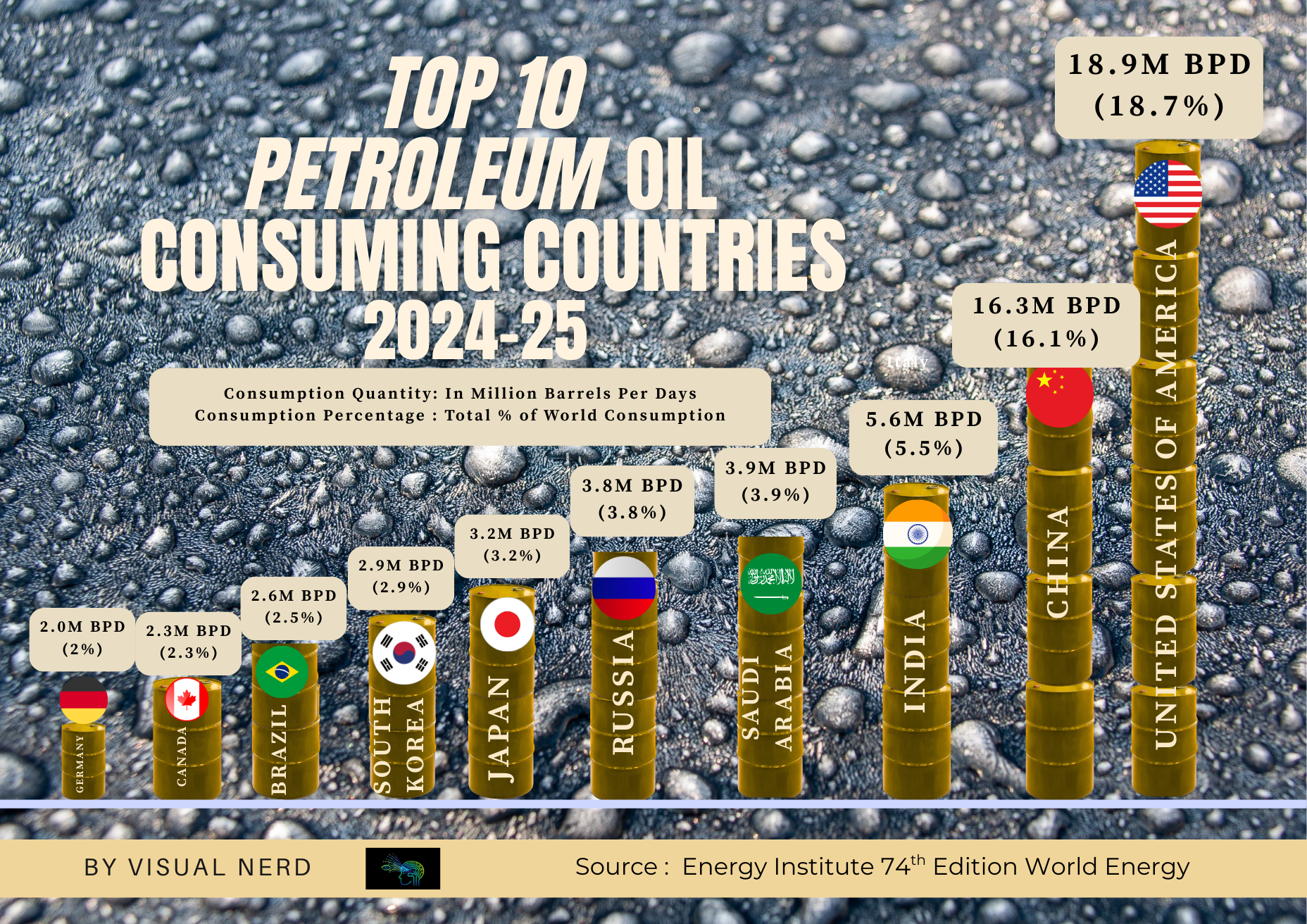
Global Oil Consumption: 2024-25 Rankings
Top 10 Oil consuming countries in 2025 are discussed in this write up. Oil continues to dominate the world’s energy mix. Its demand is concentrated in a handful of major economies. The total world production has reached 101.8 million barrel per day as of April 11,2024 while the total world oil consumption reached 99.9M bpd during this period. The top 10 oil consuming countries together accounted for about 61% of global oil demand.The data is taken from Energy Institute – 2025 – 74th edition of Statistical Review of World Energy.
📌Key Takeaways
- Top 10 Consumers accounts for 61% of overall global petroleum oil demand in 2024
- USA is the biggest oil consumer in the world and accounts for 18.7% of global consumption
- China and India follows at second and third position on the list of top 10 consumers of oil
- Oil consumption growth is on a slow curve due to participation by renewable energy sources.
Top 10 Oil Consuming Countries in 2025
| Rank | Country | Consumption (million barrels per day) | Share of World (%) |
|---|---|---|---|
| 1 | United States | 18.99 | 18.70% |
| 2 | China | 16.37 | 16.10% |
| 3 | India | 5.62 | 5.50% |
| 4 | Saudi Arabia | 3.96 | 3.90% |
| 5 | Russian Federation | 3.84 | 3.80% |
| 6 | Japan | 3.23 | 3.20% |
| 7 | South Korea | 2.89 | 2.90% |
| 8 | Brazil | 2.56 | 2.50% |
| 9 | Canada | 2.33 | 2.30% |
| 10 | Germany | 2.05 | 2% |
Global Oil Consumption: 2024-25 Rankings
✅ USA: At the top of the list, the United States consumed nearly 18.99 million barrels per day – roughly 18.7% of the global oil demand. The country’s large economy contributes to its high oil consumption levels. The widespread automobile usage also plays a role. Moreover, its heavy industrial base keeps these levels higher than any other nation.
✅China: Stands at a second position with consumption of around 16.37M bpd – covering around 16.1% of the global oil demand. This reflects its massive manufacturing sector. Additionally, there is an expanding middle class. There is also continued reliance on oil fired energy alongside rapid electrification efforts.
✅India: Ranked third, consuming about 5.6M bpd and is one of the fastest growing major oil markets globally. The rise is driven by increasing transport demand, expanding infrastructure and the growing economy that relies heavily on imported crude.
✅Saudi Arabia: Stands at a fourth position with consumption of 3.96M bpd. This is around 3.9% of world’s total consumption.
✅Russian Federation: Stands at fifth position with a consumption of 3.84M bpd that is around 3.8% of world consumption.
✅Japan: Ranks at sixth position on the list and the last one to consume more that 3 million bpd. It consumed around 3.23M bpd with a global share percentage of 3.2%.
✅South Korea: is at seventh position in the list. It consumed around 2.89M bpd with a global consumption share percentage of 2.9%
✅Brazil: Brazil has a total consumption of 2.56M bpd with 2.5% of global production share
✅Canada: Comes at ninth position with consumption of 2.33M bpd covering 2.3 % of global consumption demand.
✅Germany: Completes the list of top 10 with the consumption of 2.05M bpd and 2% share in global oil consumption.
Conclusion
In 2023-24, India’s consumption of petroleum products grew by about 5%. In 2024-25 consumption continue to increase by about 3.5%. Globally also, compared to 2023-24, oil consumption in 2024-25 showed modest growth. This was led mainly by India. Meanwhile, demand in the US, China, Japan, and Europe remained stable or slow due to efficiency gains.
In future the growth is expected to moderate as clean energy policies and implementation expands. In general, geopolitical tensions, sanctions, middle east instability, security concerns influences the oil demand, prices and long-term consumption worldwide.
Frequently Asked Questions
The United States remains the world’s largest oil consumer, using 18.99 million barrels per day, which accounts for 18.7% of global demand.
In 2025, China consumed 16.37 million barrels per day (16.1% share), while India consumed 5.62 million barrels per day (5.5% share).
The top 10 oil-consuming nations together account for approximately 61% of total global oil demand.
Japan’s consumption (3.23 mb/d) has stabilized or slowed due to significant efficiency gains and a shift toward alternative energy sources.



Leave a Reply