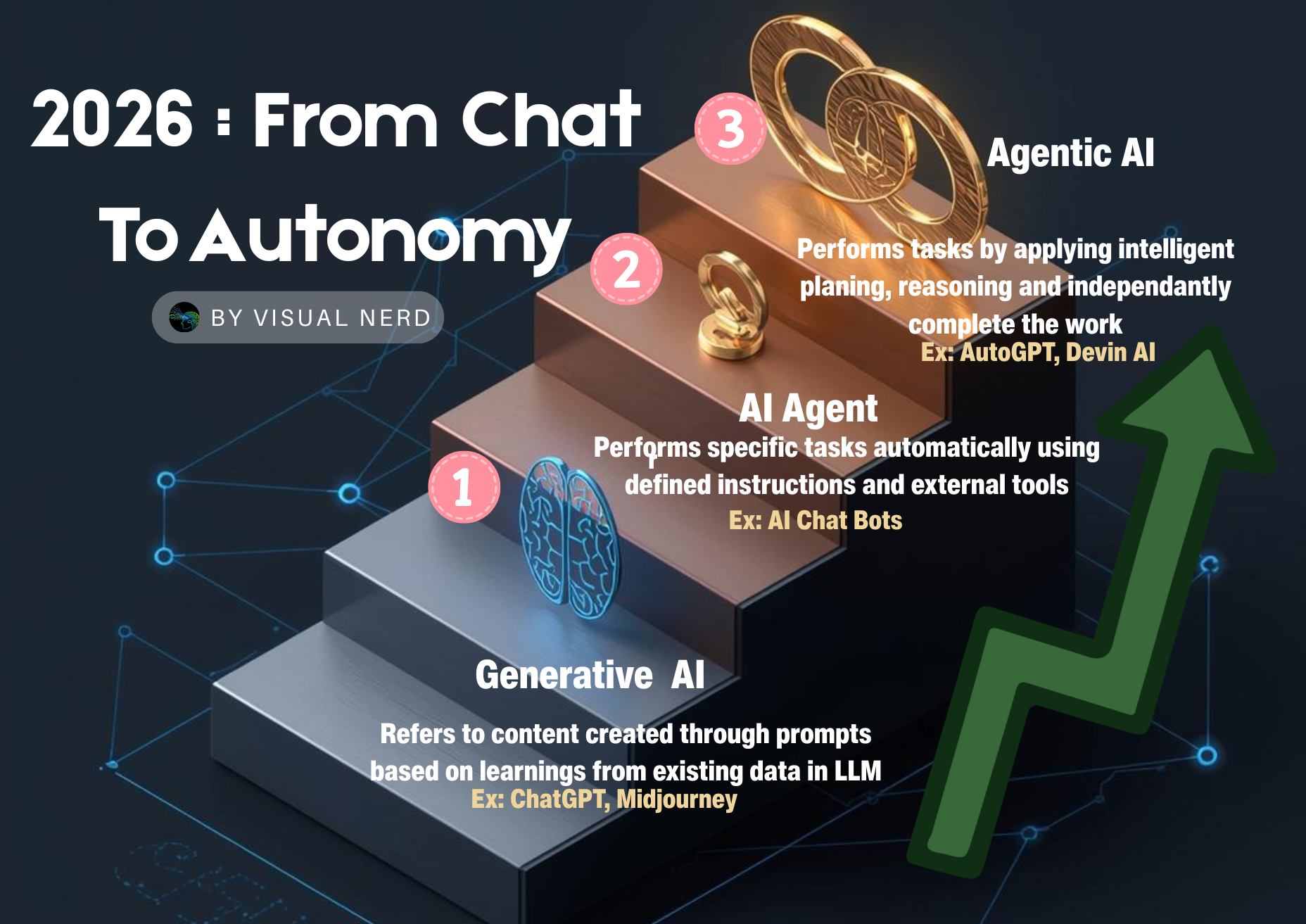
AI Evolution: 2023 ➔ 2026
Gen AI
Passive KnowledgeThe “Trapped Genius.” Excellent at research but purely reactive; requires constant human prompts.
AI Agents
Task ExecutionThe “Assistant with a Toolbelt.” Uses APIs to execute specific tasks following strict user instructions.
Agentic AI
Active AutonomyThe “Autonomous Manager.” Orchestrates sub-agents, reasons independently, and solves for goals, not just tasks.
Human Role: The Director
- Executive Vision: We move from “doing” to providing governance, ethics, and strategic direction.
- Final Accountability: Humans remain the essential audit point for critical decisions and AI outcomes.
- Proactive Flow: AI begins solving problems autonomously before they even impact the workflow.
DECISION_LOGIC_UNIT
THEN: DEPLOY_AGENTIC_AI
ELSE: DEPLOY_STANDARD_AGENT
From Chatbots to Colleagues: The 2026 AI Evolution
In 2023, most of us were galvanized by the advent of Generative AI. We provide the prompt, marvel at the response, and then copy and paste the content into the email. We were the connective tissue that completed the entire process.
Fast forward to a silent Monday morning in 2026. An Agentic AI system automatically audits your supply chain. It then negotiates a discount with your vendor. Finally, it updates your CRM. You did not have to provide the instructions; it knew the goal. This is a transition of AI from Passive Knowledge to Active Autonomy.
1. Gen AI – The Genius But Trapped Researcher
Generative AI (Gen AI) can be considered as a genius researcher with extensive knowledge. Yet, it is trapped in a room and can’t use its knowledge to complete practical tasks.
- How Gen AI works: It operates on large language models (LLMs) trained on large historical datasets using deep learning.
- Gen AI Workflow: A prompt is required to initiate this process. It analyses the LLM to generate a creative response, be it text, design, or data analysis.
- The Outcome: It can provide creative outcome after it’s analysis. For example it can give a 3 day iternary for a trip to New York for tech conference. It can suggest nearby hotels, things to pack, and even good nearby places to eat.
- Limitations: The method is purely reactive in nature and is trapped inside the room. It cannot go ahead and do the “real work” of booking flight tickets and hotels.
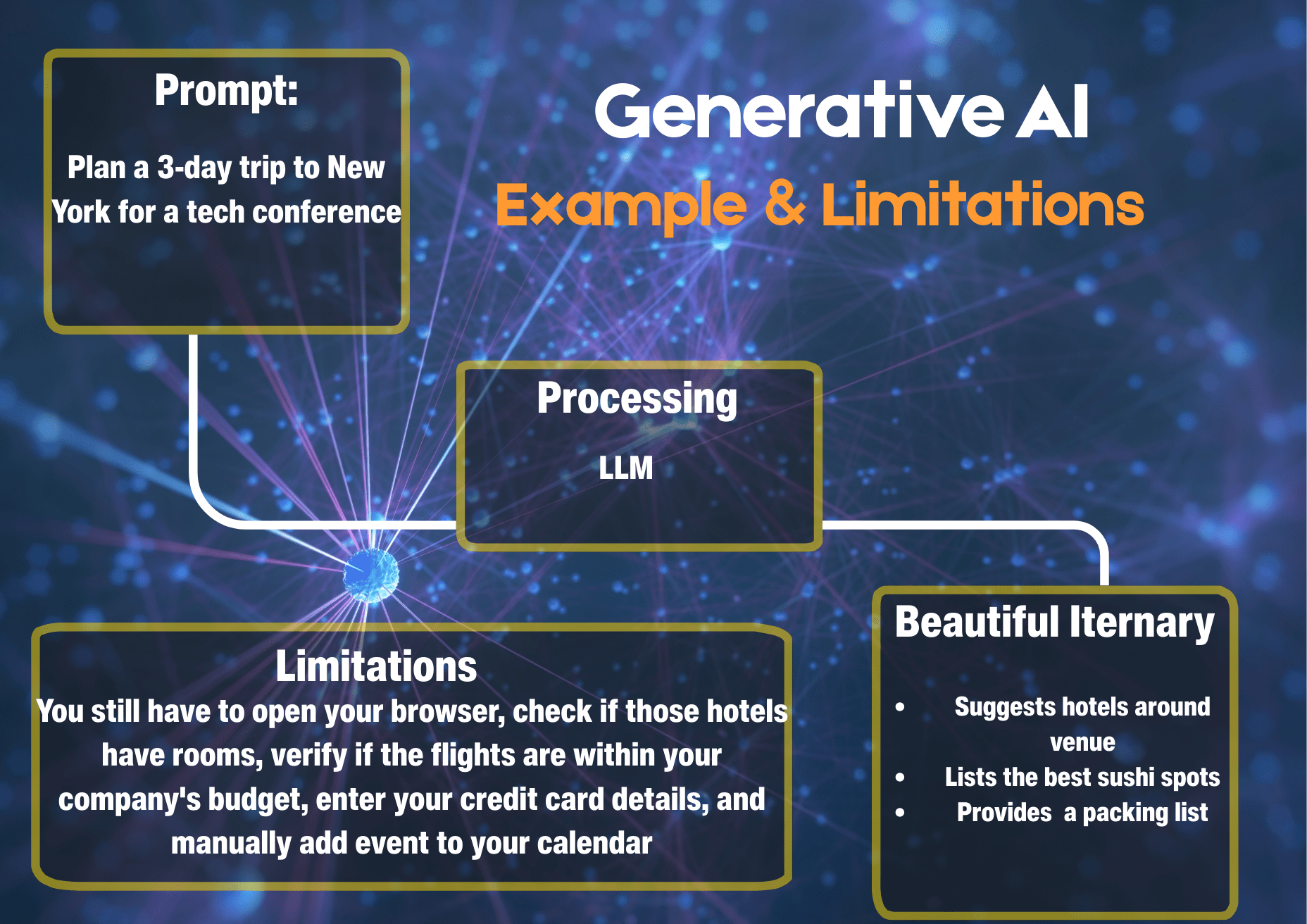
In the example below:
- Generative AI was assigned a task. It has to plan a 3-day trip to New York for a tech conference.
- It processes this on the LLM model. It comes up with hotel suggestions. It suggests what stuff you need to pack. It also identifies good places nearby to eat.
- It is not possible to finish the real task of booking a hotel and flight for you.
2. AI Agents – The Assistant with a Toolbelt
In 2025, the trapped researcher finally received a set of keys and a phone. This is the AI Agent.
- Added Capability: AI Agents can now automatically complete tasks based on instructions. They can be integrated with external tools (APIs) to interact with current data and complete tasks.
- Workflow: Provide the specific tasks with detailed instructions and an AI agent will get that completed automatically. For ex for booking a flight the budget and destination needs to be provided . The AI Agent then uses an external tool to complete the task of buying flight and hotel tickets.
- Limitations: It still operates in strict sequential model. If the instruction is to book a hotel within a budget, and it is not available, the agent faces an obstacle. This is because a blocked task can’t proceed further. It lacks situational awareness and requires instructions on the next steps.
Capability Addition With AI Agent On Gen AI
- Reasoning Loops: Agents do not just “guess”; they check. If Hotel A is unavailable, they pivot to Hotel B.
- External Tools: They live in the real world, connecting to live data rather than relying on historical datasets.
- Persistence: They work in the background. You can close your laptop; the agent continues working until the task is completed.
Consider the same example as above, and let’s see how an AI agent works in the same scenario:
- The AI Agent was assigned the same task as above. It has to plan a 3-day trip to New York for a tech conference.
- It processes this on the LLM model to get the possible itinerary. It is also integrated with a third-party booking system.
- It books the hotel and flights as per the strict instructions provided, like within the hotel and flight budget
- AI Agent is still an isolated system completing an assigned job without 360-degree awareness and the capability to reason, plan, and execute independently

3. Agentic AI – The Autonomous Manager
In 2026, with the advent of Agentic AI, we stopped managing tasks and started managing goals.
- Goal-Oriented Reasoning: Agentic AI is dedicated to accomplishing the assigned task. It plans and reasons while understanding the importance of the goal. The Agentic AI takes the necessary steps to complete it. For example, if a flight to New York is canceled, a standard AI agent sends a notification. The agentic AI realizes that this is a critical meeting for you. It autonomously finds an alternative flight, books it, and also coordinate with the tech conference organizers to adjust your engagements.
- Multi-Agent Orchestration: Agentic AI acts as a Mothership Agent that manages an “army” of individual sub-agents. For example, in the case of booking flight tickets, there is one for tracking prices. Another manages secure payments, and a third handles calendar management. This ensures that they all move synchronously.
- Self-reflection: It learns from its experiences and also always work to identify alternative ways to complete the tasks. For example if a flight booking fails, the system doesn’t just error out. It goes in a debugging mode to identify if the API is down or the error is from it’s side. More importantly, it takes the corrective steps like working with alternate vendor API to complete the task.
Consider the same example as above, and let’s see how an AI agent works in the same scenario:
- The Agentic AI was assigned a task. It has to plan a 3-day trip to New York for a tech conference.
- It processes this again on the LLM model. It is integrated with a Supervisor agent that ensures regular tracking and alternative workflows as per the situation. For example, if a flight is canceled, it will automatically book a new flight. It will make decisions based on the seriousness of the situation. It will go further and get your appointments rescheduled as per your new schedule.
- Agentic AI is an integrated system. It is tasked with completing an assigned job with 360-degree awareness. It has the capability to reason, plan, and execute independently.

Key Aspects: Gen AI Vs AI Agent Vs Agentic AI
| Attribute | Generative AI | AI Agent | Agentic AI |
|---|---|---|---|
| Purpose | Content creation through prompts based on data patterns. | Specific task execution using instructions and tools. | Goal completion via independent planning and reasoning. |
| Metaphor | A genius researcher trapped in a room. | Researcher is out of the room using specific tools. | The Independent Director managing the entire project. |
| Access | Core LLM models only. | LLM + basic tool integrations (APIs). | LLM + Multi-tool APIs + Supervisor coordination. |
| Examples | ChatGPT, Gemini | Lindy AI, Zapier Central | Crew AI, TrueFoundry |
| Automation | Low | Medium | High |
Visual Nerd “Quick Score” Tool For Deciding Agent AI or Agentic AI For Your Use Case
We suggest our readers use a simple tool. It helps to decide if you need AI Agent or Agentic AI for resolving your use cases. Readers can score from 1-10 for each of the three questions below. If the overall score is more than 22, they need an Agentic AI.
- Complexity (1-10): Number of sub tasks involved? (1 = Single Sub Task; 10 = Dozens of Sub Tasks).
- Variability (1-10): How frequently do the rules change? (1 = Static rules; 10 = Constant changes).
- Importance (1-10): If it fails, how bad is it? (1 = No big deal; 10 = Business critical).
AI Agent Vs Agentic AI Selection Calculator
Should you use an Agent or Agentic AI?
The Final Verdict – Future of AI autonomy 2026
The journey from 2023 to 2026 has been a move from “Chatting” to “Operating.”
- Role of the Human In AI Era: We are no longer the “copy-paste” workers. We are the Directors. We provide the ethics, the vision, and the goals.
- The Future: AI will soon move into “Ambient Autonomy,” solving problems before we even realize they exist.
The journey from Genetic AI to Agentic AI can be classified as a move from “Chatting” to “Operating”.
The Future
AI is moving towards “Ambient Autonomy.” It is resolving problems more proactively. AI is also taking on increasingly complex coordination tasks.
Role of the Human: Humans are moving from the “doer” role to a more “hybrid ” role.
- Ethical Guardrails: Humans are responsible for building guardrails. They ensure that AI implementation remains within these rules. They also ensure that the AI does not infringe on copyrights or lead to the leakage of private data.
- Accountability & Governance: Humans should ensure that any mistake from AI is covered. For example, if AI makes a wrong medical diagnosis, it should be reviewed and corrected by a human.
Data Sources Referenced


Leave a Reply