
Tata Group’s Net Worth – Solid Pillar of India’s Economy
India’s economy and Tata Group’s progress have gone hand in hand. Tata Group’s net worth and Indian GDP have been on a similar upward trajectory for the last 34 years. No other brand has managed to link itself with the Indian psyche as this group did. The most important aspect is that this is done in a way that highlights the character. It also emphasizes the larger business purpose, i.e., social welfare.
Tata Group’s Net Worth – Contribution To Indian GDP
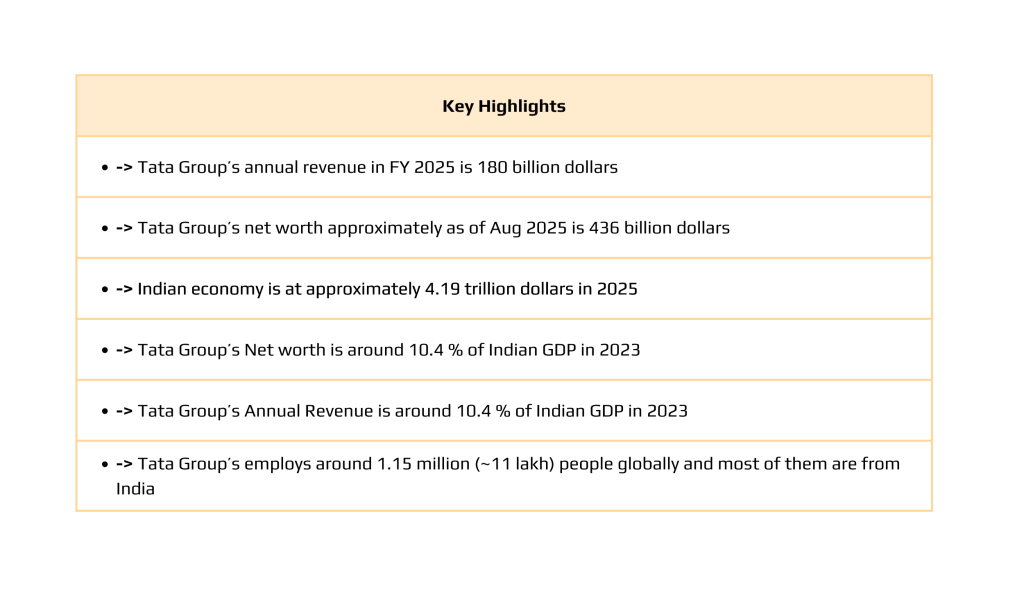
Tata group is a conglomerate and Tata Sons is the holding parent company of the group. It has 29 publicly listed affiliate companies. Tata group’s market capitalization is based on the total market value of these 29 companies. This includes giants like TCS (Tata Consultancy Services), Tata Steel, and Tata Motors, among many others. As of August 2025, Tata Group’s market capitalization was approximately estimated to be around 436 billion dollars. This is by far the largest Indian conglomerate. Net worth valuations are market dependent and are prone to change with reporting date and precise method being used.
Tata Group’s contribution to India’s GDP – Overall Net Worth Vs Total GDP
Though no direct comparison is available publicly, we can come up to a figure by comparative analysis. As per IMF, India’s GDP in 2025 is 4.19 trillion dollars. It shows that the Tata group’s net worth is around 10.4% of overall Indian GDP roughly.
Tata Group’s Annual Revenue As a Percentage of Indian GDP
The Tata Group’s annual report for financial year 2025 provides an estimate. It states that the total revenue for the entire Tata Group was ₹15.34 lakh crore (US$180 billion).This includes the aggregated revenue of all companies within the Tata conglomerate. Annual revenue is more appropriate metric to gauge Tata group’s contribution to Indian economy on yearly basis.
Tata Group’s contribution to India’s GDP – Annual Revenue Vs Total GDP
With 180 billion dollar annual revenue, Tata Contribution to Indian GDP stands around 4.2% to the annual GDP.
Also Read:
Historical Trend – Tata Group’s Annual Revenue vs Indian GDP Growth
We are comparing the Tata group’s revenue growth to the Indian GDP from 1991 to the current time frame (2025). The reason for choosing 1991 is due to two reasons. Firstly, this is a year when India implemented major policy changes. These changes started the phase for liberalization and closer integration with the world economy. Secondly, the Tata group’s command was transferred from one doyen Sir J.R.D Tata to Sir Ratan Naval Tata.
In the graph above and table below, the Indian economy has increased by around 15 times in comparison to 1991. Nonetheless, the Tata Group’s overall net worth growth is around 45 times in the same period.

India was looking to integrate with the world economy to reap the benefits of globalization. Similarly, Tata Group had also gone global with a list of important acquisitions. Tata Group has proved its business acumen. They took over companies like Corus Steel and Tetley, which were not performing. They transformed these companies into powerful entities.
The period from 2000 to 2008 was very interesting. Tata Group made many acquisitions during this time. They consolidated their global presence. During this time, the Indian economy passed the milestone of 1 trillion dollars in GDP. This is the period when India started gaining serious recognition as a player of scale. Large acquisitions by predominantly India-based Tata Group companies helped solidify this impression. India began to earn its well-deserved place at the world’s round table. The nuclear energy deal with western countries during this time is a major example.
Tata Group’s contribution to Indian Society
Tata group is the largest conglomerate from India and its success is directly linked to India’s success. Tata group is a symbol of integrity and philanthropy. It signifies doing business for a good cause. Above all, it is a century-old institution with a long tradition of doing things ethically. Tata group is very widely involved in India’s development with 66% of the group’s profits are held by philanthropic trusts. This helps uplift millions across the country. Group’s philanthropic efforts are focused on important sectors like rural development, healthcare, infrastructure, and education.
It employs around 1.15 million (around 11 lakh) people globally. A large proportion of these employees are mainly in India.
Conclusion
The fact that the Tata group has helped India in reaching significant industrial milestones is a continuous journey. In the process they have been on a spree of acquisition and innovations. One fine example was a decision to develop self adequate indigenous technologies for manufacturing commercial and passenger cars. They continues to grow and make bets. In the 2020’s, they have acquired Indian Airlines and are also doing this by manufacturing the iPhones in India. Similarly, Tata Steel, the largest steel manufacturer in India, has played a pivotal role. It has been essential in infrastructure development on a large scale.
Tata group is not only a conglomerate but it’s a symbol of India’s development and economic progress. With it’s business in around 100 countries it’s a running brand ambassador of India. It’s logical as Tata Group net worth grows, Indian global influence is bound to increase, especially when considering Tata Group Net Worth in Rupees.
If you have come this far, we believe you have liked the article. Please click on these links to find articles on Economy.


Leave a Reply