Even With Fastest Growth In Major Economies: Why India Slipped to 6th In GDP Rankings
The $4 Trillion Optical Illusion
India is the fastest growing major economy with 6.5% growth, yet it slipped to 6th in GDP rankings. This drop is statistical illusion, not structural– driven by INR depreciation and statistical rebasing rather than economic cooling.
- The Paradox: Indian GDP growth of 6.5% is a fact and ranking slip is more of a temporary statistical outcome
- Currency Drag: INR depreciation around 10% has led to USD “shrunk” the economy on paper.
- Data Correction: MoSPI rebased the benchmark year leading to 3-4% of decline in overall GDP in INR
- Recovery Path: IMF projects India reclaiming the 4th spot by 2027 and 3rd by 2031.
India retains its prized accolade of being the “fastest growing major economy” in the April 2026 IMF World Economic Outlook Database. However, it has slipped to 6th ranking in terms of nominal GDP. A logical question is – India Is a $4 Trillion Economy – So Why Did Its Global Rank Fall?
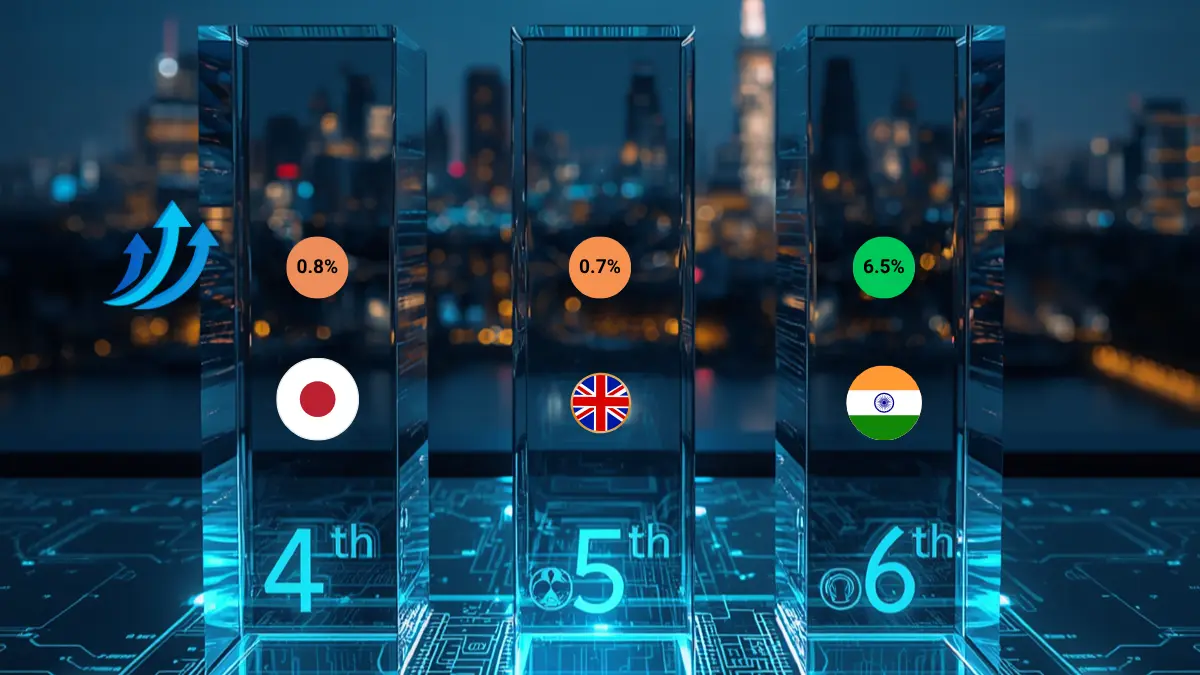
The current rankings have Japan (4th | $4.38T), the UK (5th | $4.26T), and India (6th | $4.15T). A deeper look suggests that this drop is largely superficial, as the Indian growth engine has not stopped, nor is India’s economy slowing down. The drop is largely due to a combination of statistical corrections and INR volatility against USD.
- The Currency Headwind: Nominal vs. Real GDP
Loading Interactive Data…
The rankings provided by the IMF are based on the Nominal GDP calculated in US dollars. Even though India’s economy grew in Rupee terms, when those rupees were converted to dollars (USD) for the global ranking, the total value appeared smaller compared to peers like the UK and Japan
- INR Depreciation Against USD: In the last 2 years ( 2024–2026), the Indian rupee has slid from ~₹84.5 to ~₹88.5 per dollar. Some spikes have taken it to even ₹93 due to global oil price surges.
- Impact: The IMF converts the total economy of a country into US dollar terms. Indian growth has suffered from this ~5-10% depreciation, and the overall value of the economy has reduced.
India’s GDP growth has seen consistent upward trend and detailed journey is highlighted in our India’s GDP Journey Through 2009 to 2026
- The Statistical Correction: Base Year Revision
India’s Ministry of Statistics(MoSPI) notification in Feb, 2026 shifted the GDP base year from 2011-12 to 2023.This ‘rebasing’ is standard practice to incorporate newer data sources and improve accuracy.
- More Accurate, but Smaller: However, the revision revealed that previous estimates slightly overestimated the economic size (by roughly 3 to 4% ).
- Adjustment Imapct: This resulted in the revised downward nominal GDP estimates of ₹345.5 trillion instead of the previously estimated ₹357 trillion in the old series. This overall downward movement has also contributed to the overall reduction in the economy size.
3. The “Stagnant” Lead: UK & Japan’s Resurgence
While India’s ranking slipped, the United Kingdom and Japan saw marginal improvements that allowed them to edge past India.
1. The UK benefited from a stronger-than-expected recovery, with GDP growth beating the initial forecast.
2. Both Japan & UK had more stable currency performance related to the dollar during the specific window, helping them maintain their dollar-denominated valuations.
The Bigger Picture: Growth Vs Ranking
It is important to distinguish between ranking and growth. Despite slipping to sixth place, India remains the fastest-growing major economy in the world. India vs UK GDP comparison April 2026 along with Japan is depicted below.
Global GDP Rankings: April 2026
Source: IMF World Economic Outlook (Current Prices)
Conclusion
Economics views this as a temporary ‘nominal’ setback. India’s real GDP growth has been consistent (6.5%) in 2026, and the ranking drop is purely a result of dollar conversion and base-year normalization.
As India’s growth rate is significantly higher than that of UK, japan and Germany, the IMF projects India will regain the fourth spot by 2027 . India is projected to become third largest economy by 2031.
Frequently Asked Questions
India’s GDP growth has led to massive urbanization. Please read our article: Why 2 Out of 3 People in World will live in Urban area in 2050.


Leave a Reply