Largest Shareholder Countries In World Bank
Who owns the world bank? The article covers the major institutions within the world bank. It explains how their voting power is distributed among the member countries. The data for this article is taken from World Bank website.
The World Bank group is among the world’s most influential financial institutions. It’s purpose is very noble: to reduce poverty and promote sustainable development in the world. At its core, it has two key institutions. These are the International Bank for Reconstruction and Development (IBRD) and the International Development Association (IDA). Together these two are collectively working as the World Bank organizations serving countries that are at different income levels.
Also Read:
Top 10 Countries By Voting Power in World Bank
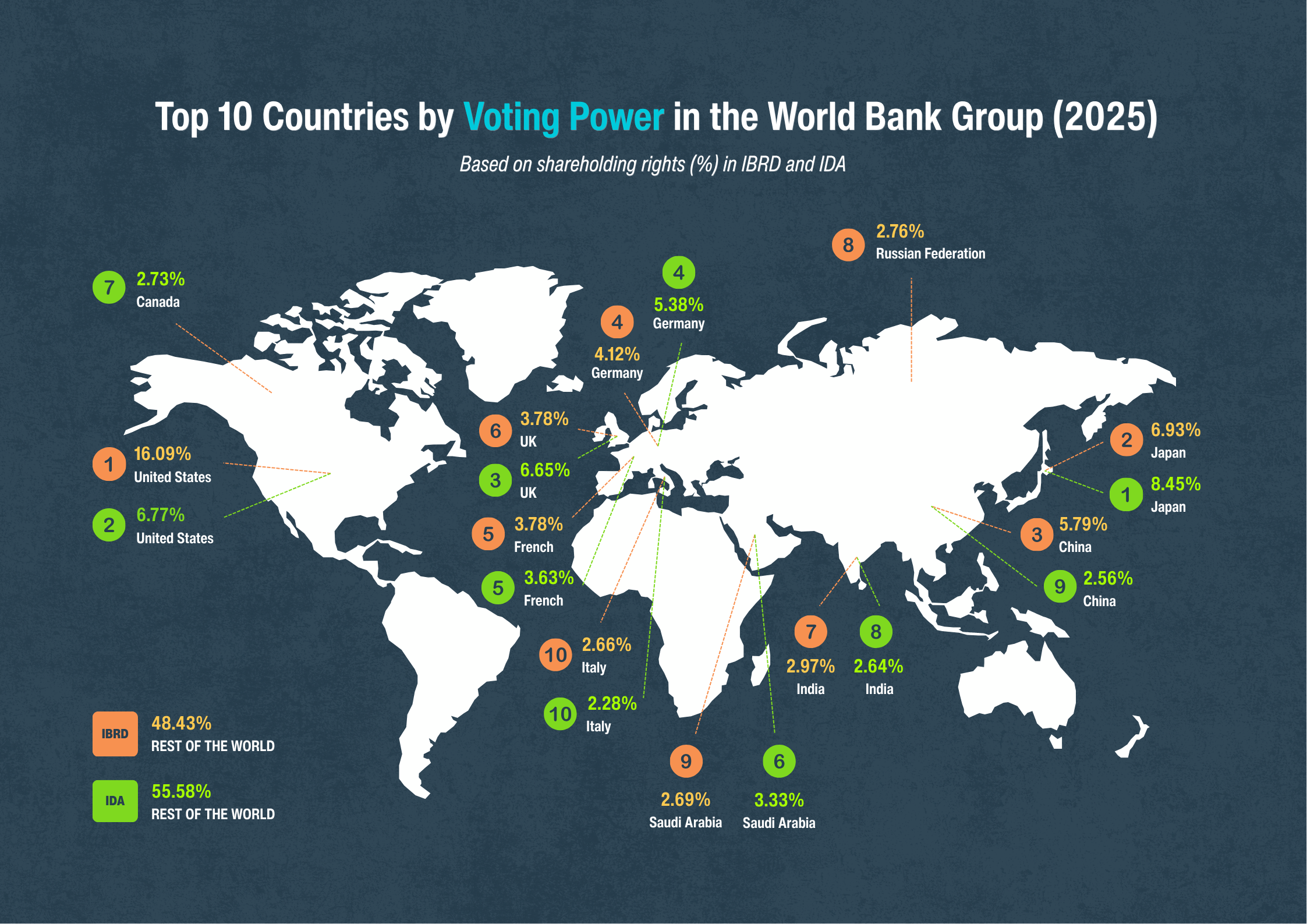
The image below highlights the top 10 World Bank Shareholders List in respective institutions: IBRD and IDA.

International Bank for Reconstruction and Development (IBRD)
IBRD was established in 1944 originally to help rebuild Europe after World War II. Overtime it’s role expanded to providing financial and technical support to middle income and credit worthy low income countries.
It offers low interest loans, developmental credits and policy advice for projects that drive growth and reduce poverty. These include initiatives in infrastructure, education, healthcare, renewal energy and governance reforms.
Shareholder Countries of International Bank for Reconstruction and Development (IBRD)
Table Depicting Top 15 IBRD Shareholder Countries by Voting Percentage
| Country | # of Shares/Votes | % of Total Shares/Votes |
|---|---|---|
| UNITED STATES | 466,313 | 16.09 |
| JAPAN | 200,736 | 6.93 |
| CHINA | 167,710 | 5.79 |
| GERMANY | 119,429 | 4.12 |
| FRANCE | 109,462 | 3.78 |
| UNITED KINGDOM | 109,462 | 3.78 |
| INDIA | 86,026 | 2.97 |
| RUSSIAN FEDERATION | 79,972 | 2.76 |
| SAUDI ARABIA | 77,818 | 2.69 |
| ITALY | 76,995 | 2.66 |
| CANADA | 71,306 | 2.46 |
| NETHERLANDS | 54,962 | 1.90 |
| BRAZIL | 54,360 | 1.88 |
| SPAIN | 53,746 | 1.85 |
| MEXICO | 48,571 | 1.68 |
It finances its operation partially through the global bond markets. It uses its strong credit rating to borrow funds at low cost. These funds are then lent to developing nations on favorable terms. It gets major funding through member countries.
Also Read
✅IBRD Shareholding Approach for Member Countries:
Shareholding is based primarily on the capital each member country subscribes while joining the bank. It also changes during the reforms undertaken by the bank at regular intervals.
Every member country buy shares when it joins or through reforms. The number of share determines that countries financial contribution and voting power. Share shows a mix of:
- Paid in capital: The part of the capital that the country actually pays in cash for gold.
- Callable capital: This is the part of capital the country commits to pay. The payment is made only if the bank faces a financial emergency.
✅Voting Rights for IBRD Member Countries
Each member country’s voting is composed of
- Basic votes: Same for all members to guarantee equality
- Share votes: Based on the number of shares owned by each country.
So countries that subscribe to more shares have greater influence. For example, the United States holds about 16.09% of IBRD shares giving it virtually a veto power since major policy decision requires a 85% majority. World Bank Largest Shareholders include China, Germany, UK, France and India.
The world bank reviews shareholding periodically (called General Capital Increases). During these reviews, members can buy additional shares. It ensures representation that aligns with the evolving World economy. For example, in 2010, the voting power of developing countries was increased by 3% to adjust to evolving world situations.
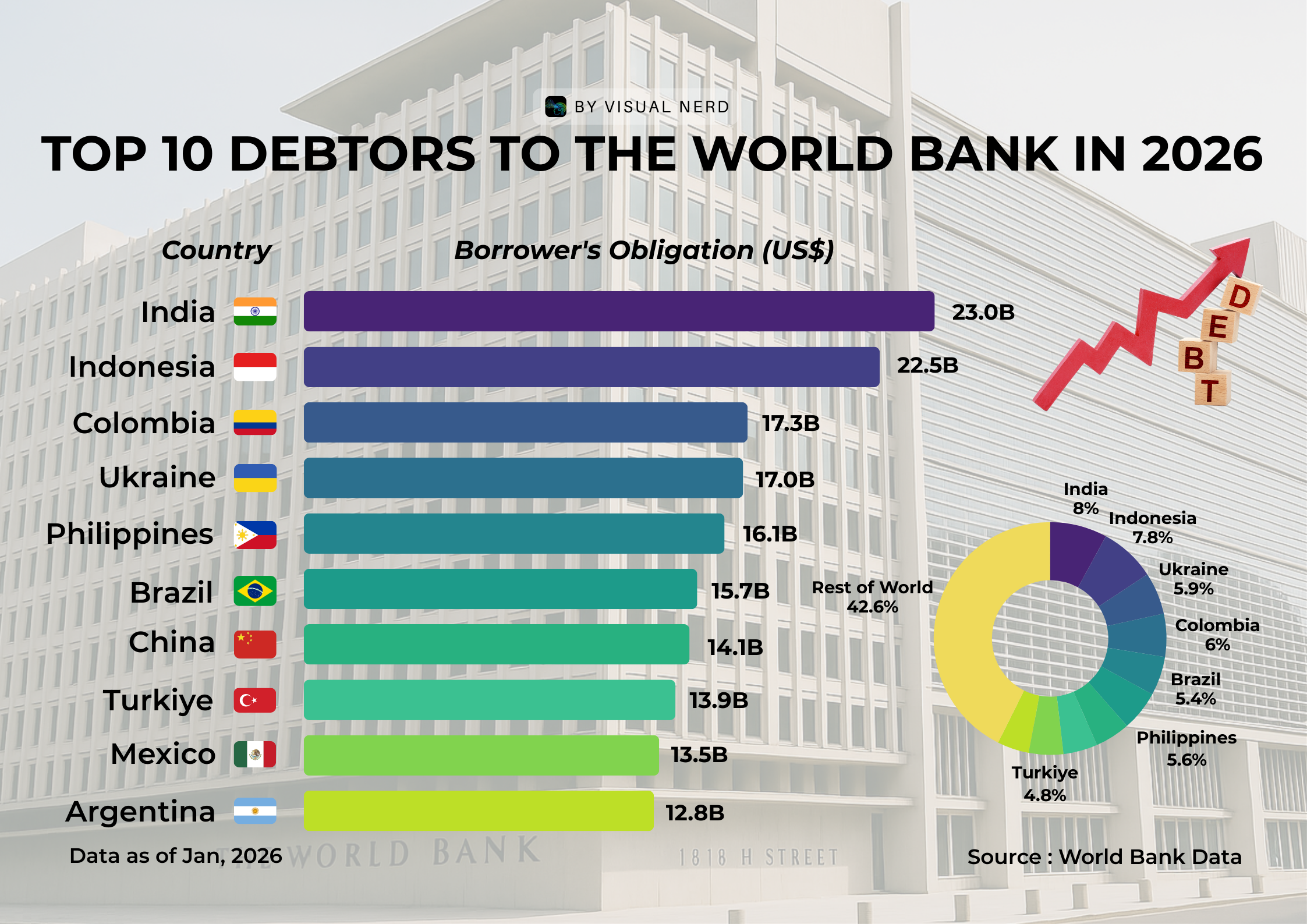
IBRD clients include countries like Brazil, India, Indonesia, and Mexico. These countries use its assistance to modernize industries. They create jobs and strengthen economic resilience.
International Development Association (IDA)
The IDA was founded in 1960 and serves as the concessional arm of the World Bank. It’s mission is to help the poorest countries that can’t afford to borrow at market rates. IDA provides interest-free loans, grants and technical assistance to support critical areas like healthcare, agriculture, education and climate adoption. It plays a crucial role in reducing inequality and fostering inclusive growth.
✅IDA shareholding
The IDA shareholding is not base on capital stock like the IBRD. Instead it’s influence is tied to financial contributions made by countries during replenishment rounds which occur every 3 years.
| Country | # of Shares / Votes | % of Total Votes | 2026 Status |
|---|---|---|---|
| JAPAN | 2,736,070 | 8.45 | ↑ Top Pledger |
| UNITED STATES | 3,166,780 | 6.77 | Stable |
| UNITED KINGDOM | 2,254,407 | 6.65 | Stable |
| GERMANY | 1,745,375 | 5.38 | Stable |
| FRANCE | 1,273,031 | 3.63 | Stable |
| SAUDI ARABIA | 1,078,465 | 3.33 | Stable |
| CANADA | 884,666 | 2.73 | Stable |
| INDIA | 652,166 | 2.64 | ↑ Rising |
| CHINA | 831,066 | 2.56 | Stable |
| ITALY | 738,811 | 2.28 | ↑ Increased |
| SWEDEN | 705,657 | 2.18 | Stable |
| NETHERLANDS | 682,486 | 2.10 | Stable |
| POLAND | 616,720 | 1.60 | ↑ Emerging |
| BRAZIL | 477,666 | 1.47 | Stable |
| SWITZERLAND | 461,050 | 1.42 | Stable |
Expert Insights:
You have wondered that – Why USA had more shares but lower voting percentage?
The United States retains the largest shareholder spot in the absolute number of shares. Yet, Japan holds the highest voting power in 2026. This is due to the IDA-21 replenishment. The voting power is heavily weighted towards voluntary financial contributions rather than just original member shares.
Countries like India and Poland have seen minor increases in their influence. They are transitioning from being “borrowers” to significant “donors” in the global financial system.
✅IBRD – Source of Funding & Voting Rights
Donor countries, mostly high-income nations, contribute funds to IDA’s pool. The more a country contributes, the larger its voting power becomes. Recipient countries, the poorest nations, also become members. Nevertheless, their voting share is small since they don’t contribute financially at the same scale.
Every 3-year cycle (example ID A21: 2025-27) includes negotiations among members. Members decide how much each country will contribute. These negotiations directly influence the distribution of voting power and the governance structure of the IDA.
IBRD VS IDA : Shareholding and Purpose
| Aspect | IBRD | IDA |
|---|---|---|
| Basics of Share Holding | Capital Subscription (Shares purchased) | Donor Contributions ( Replenishment) |
| Loan Type | Loans at near-market or low interest rates | Interest-free loans (credits) and grants |
| Repayment Terms | 15–30 years with interest | Long-term (up to 40 years), often with a grace period |
| Voting Powers | Based on shares + basic votes | Based on contributions from donor countries |
| Top 5 Shareholder Countries | USA, Japan, China, Germany and France | Japan, USA, UK, Germany and France |
| Sample Client Countries | India, Brazil, Indonesia, China | Afghanistan, Chad, Haiti, Mozambique |
In simple terms:
✅In IBRD, the voting power comes from how much capital a country invests.
✅In the IDA, the power comes from how much money a country contributes during donor replenishment exercises.
Conclusion
The IBRD and IDA complement each other, addressing different stages of economic development across the globe. The IBRD supports financially stronger nations in sustaining growth. The IDA helps the world’s poorest countries meet basic needs. It also builds a foundation for long-term progress. Together they embody the world bank’s mission to create a more equitable, resilient and sustainable global economy.

Leave a Reply