Executive Summary
Top Debtor Countries to the World Bank (2026)
India – Leads the List
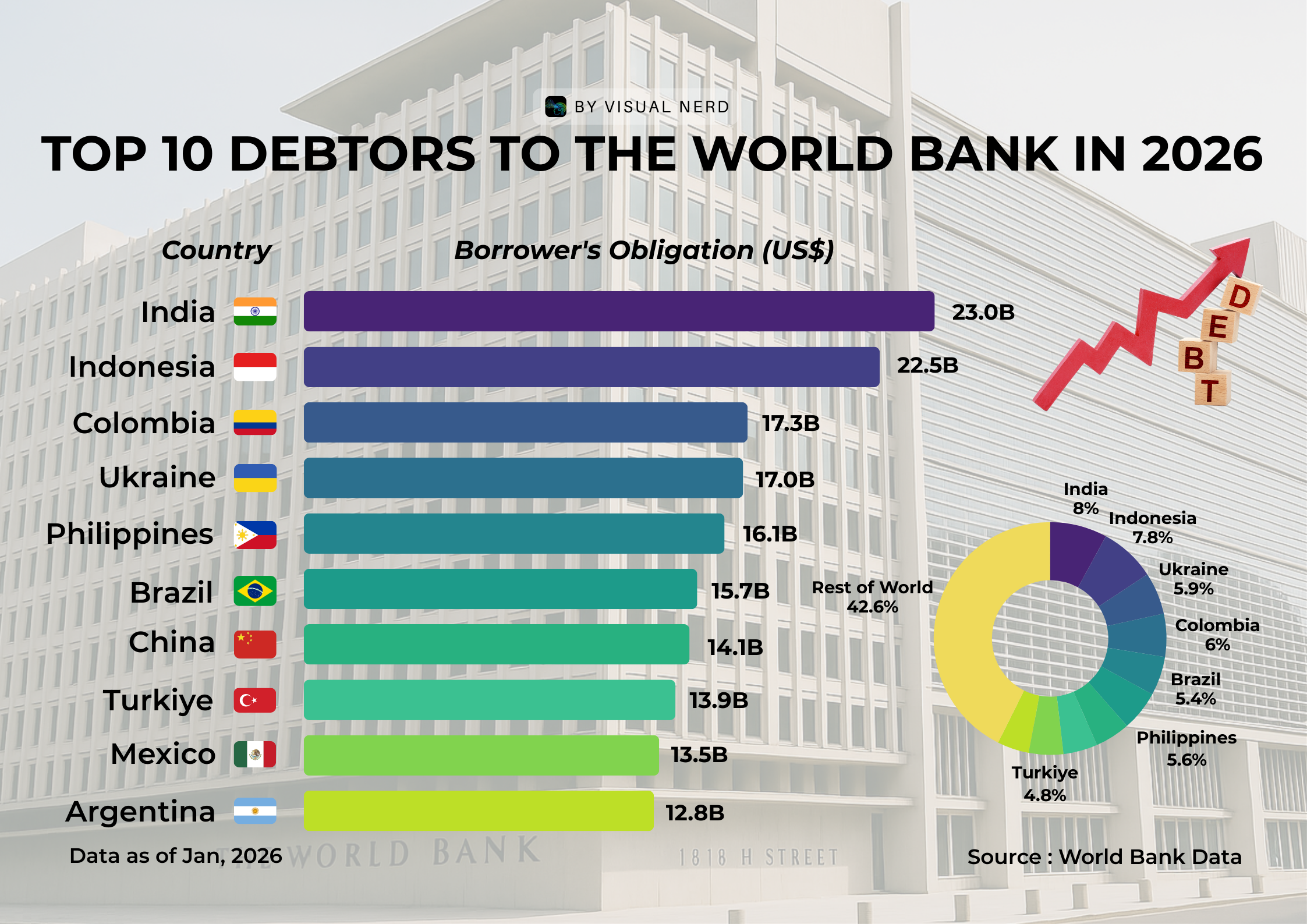
India is the world’s largest IBRD borrower with $23.08 Billion USD attributing for 7.97% of the World Bank’s total debt amount.
High Debt Concentration
58%of the total debt pool of World Bank is collectively hold by top 10 borrowers , highlighting a massive concentration of capital.
Strategic Loans
Ukraine’s debt ($16.97B) is rising at a fast pace due to World Bank’s help toward financing critical reconstruction and humanitarian aid imapcted due to ongoing war.
IBRD Vs IDA
IBRD focuses primarily on middle-income nations for improving infrastructure and urban development, while IDA concentrates on poorest nations to improve basic services like drinking water, sanitation.
World Bank Debt Obligations & Insights (2026)
The top debtor countries to the World Bank in 2026 are illustrated in the above infographic. These loans are guaranteed debt extended by the World Bank. The data is obtained from the International Bank for Reconstruction and Development (IBRD). Calculated using historical rates, the data figures are in US dollars. It is current as of Jan 31, 2026. The most recent snapshot of the Statement of World Bank Loans Country Wise is included in this dataset.
Brief History of the World Bank
The World Bank was formed in July 1944 for rebuilding and stabilizing the global economy after World War II. It provided long-term loans for reconstruction and development projects to rebuild war-torn countries. Overtime focus shifted toward developing countries and poverty reduction.
Also Read
World Bank Vs International Monetary Fund
The IMF and the World Bank are two global institutions for helping countries on two different economic fronts. IMF focuses on monetary stability and short-term sustainability, while the World Bank emphasizes long-term development and reconstruction. In 1947, France was the first country to obtain 250 million USD for post-war reconstruction from the World Bank.
World Bank Objectives
In the current world, the World Bank plays a vital role in global economic development. Here are its main purposes:
✅Poverty reduction and economic development: The World Bank’s primary mission is to reduce poverty. It aims to uplift living standards. They achieve this by providing financial and technical assistance. This assistance is aimed at improving infrastructure, healthcare, education, agriculture, and more.
✅Funding for development projects: It offers low-interest loans, grants, and credits to the government and public institutions. These support long-term investment in infrastructure and services. Such support is essential for sustainable growth.
✅ Promoting economic reforms: The World Bank helps countries to implement structural reforms. These reforms include improving governance, reducing corruption, and building institutions. It also encourages private sector development.
✅Data research and policy advice: The World Bank helps countries in making evidence-based policy decisions. It publishes reports like the World Development Reports. It also publishes the Doing Business Report and the Poverty and Shared Prosperity series.
✅ Global Partnerships and coordination: It plays a central role in crisis response, such as the COVID-19, global financial crisis. It works with governments, NGO’s, the private sector, and international institutions to coordinate development strategies.
✅Sustainable development and climate action: The World Bank also invests heavily in climate resilience, green energy, and Environmental Protection.
The World Bank has two main arms, IBRD (International Bank for Reconstruction and Development) and IDA (International Development Association).
| Feature | IBRD | IDA |
|---|---|---|
| Target Countries | Middle-income and creditworthy low-income countries | Poorest and most vulnerable countries |
| Loan Type | Loans at near-market or low interest rates | Interest-free loans (credits) and grants |
| Repayment Terms | 15–30 years with interest | Long-term (up to 40 years), often with a grace period |
| Funding Source | Borrowed from global financial markets | Contributions from donor countries |
| Purpose | Infrastructure, public services and development reforms | Poverty reduction, basic services, disaster recovery |
| Example Countries | India, Brazil, Indonesia, China | Afghanistan, Chad, Haiti, Mozambique |
You May Like These
Top Debtor Countries to the World Bank In 2026
In this article, we focused on IBRD-provided debts. In 2026, several countries stand out as top debtors to the World Bank.
Top 10 World Bank borrowers are discussed below in detail.
- India – India tops the list with around 23 billion USD in outstanding debt to the World Bank. These funds support a wide range of sectors, including infrastructure, renewable energy, rural development, and education. India’s large and growing economy continues to leverage World Bank assistance to meet its development goals and reduce poverty. Historical IBRD reports show that India is gradually reducing its loan exposure to the World Bank. This reduction is based on the country’s flourishing economy. Nonetheless, the overall figure will take time to show this change, as these are long-term loans. It accounts for around 7.97 % of the total amount obligated to the World Bank.
- Indonesia – Indonesia’s debt support programs are in transport infrastructure, disaster resilience, education, and Environmental Protection. The country is also actively investing in climate adoption and clean energy.
- Columbia – Columbia has around 17 billion USD in obligated amount. Funds are mostly used for rural development, social protection, and infrastructure.
- Ukraine – Ukraine’s debt is mainly mobilized due to the ongoing war. Bank funds are critical for reconstruction, economic recovery, and humanitarian aid. It also has around 17 billion USD in obligated amount to the World bank and it’s on an upward trajectory.
- Philippines – The country has around 16 billion USD in World Bank obligated amount. The country relies on World Bank loans for financing disaster preparedness, social welfare, infrastructure modernization, and pandemic recovery efforts.
- Brazil – Brazil has around 15.6 billion USD in obligated amount, and around 7 billion USD are still not disbursed. These funds are used for Amazon conservation, health care, and urban development.
- China – China has around 14.1 billion USD in World Bank debt. It focuses on pollution control, poverty alleviation, and rural infrastructure improvements.
- Türkiye – With around 13.9 billion USD in World Bank debt, Türkiye is in 9th position on the list. Loans are used for urban development, agricultural modernization, and social inclusion.
- Mexico – The country has a current debt of around 13.5 billion USD from world bank. It is mainly used to support water infrastructure, social welfare, and energy infrastructure development.
- Argentina – Takes the last spot with around 12.8 billion USD in obligated amount. A loan is largely used to support the macro-economic stabilization. Argentina is the largest borrower from the IMF as well. Apart from this, the poverty reduction amidst inflationary cycles is a key task for which this loan is being utilized.
✅ Final Takeaway
World Bank’s top 10 Borrowers are India, Indonesia, Ukraine, Colombia, Brazil, the Philippines, China, Mexico, Türkiye, and Argentina. They hold more than 58% of the total obligations to the World Bank. The loans are used strategically by these countries to improve their economy, infrastructure, and poverty alleviation. A lot of countries, like India, China, and Indonesia, have managed to use these long-term loans for their betterment.

Leave a Reply